
Owning Your Culture with Eve Chery of C'est Si Bon Pikliz
LISTEN ON: APPLE | SPOTIFY
Eve Chery has always loved to cook. But it was not until she became a mother and found herself searching for more flexibility that she decided to turn that love into a business. What started as a signature item in her catering company, Crayol Catering, became something she could not ignore. Every event, every dinner, every gathering, guests wanted to take the Pikliz home. Phone calls came in asking for more. That was the signal.
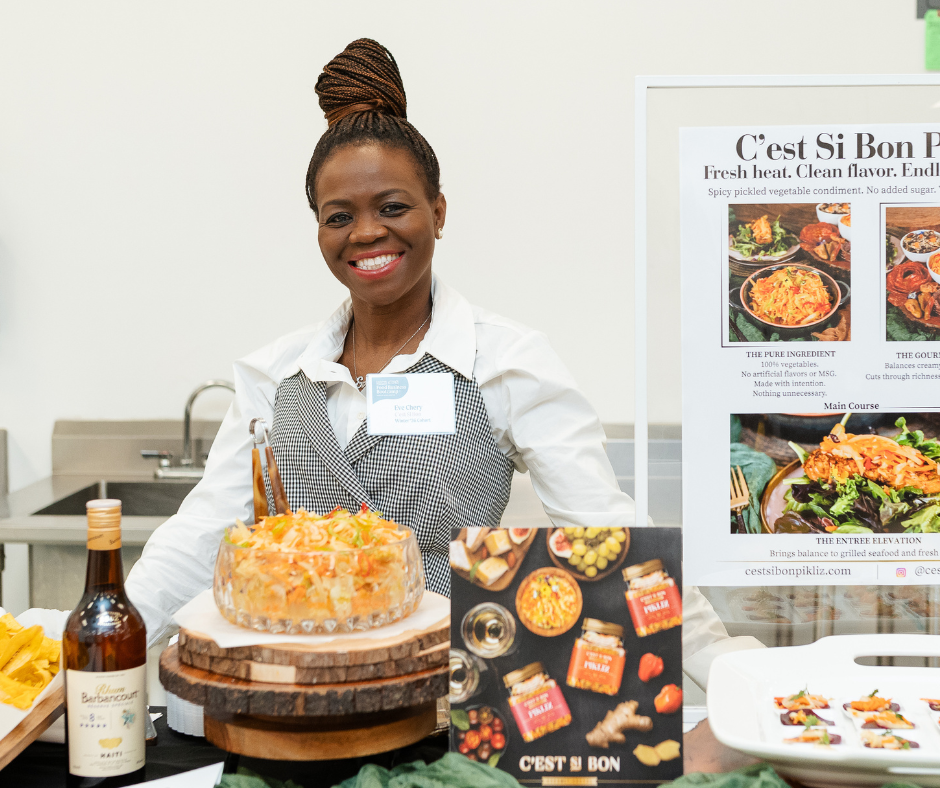
C'est Si Bon Pikliz is a spicy pickled condiment rooted in Haitian culture. A staple found in 99 percent of Haitian households, it is the kind of versatile, flavor-forward product that goes with everything. Eve sent her recipe to Cornell for food processing years ago and then sat on it for five years, unsure of what to do next. The Food Business Bootcamp changed that.
In this conversation, Eve talks about the product, the culture behind it, and the unexpected personal discovery she made along the way: she had been subconsciously trying to remove her Haitian identity from her brand, and the bootcamp helped her see why owning who she is is exactly the point.
Subscribe to the Food Means Business Podcast with Hudson Kitchen founder Djenaba Johnson-Jones to hear the personal stories and "secret ingredients" of abandoning your day job and starting a CPG food business.
Tune in to hear…
How an 11-month maternity leave sparked the idea for a food business
What C'est Si Bon Pikliz is, where it comes from, and why it became the most requested item at every catering event
How the Food Business Bootcamp helped Eve move a recipe she had been sitting on for five years
Why she does not want her product to be in the ethnic aisle, and how brands like sriracha and kimchi showed her another way
Why the bootcamp forced her to make decisions she had been avoiding and what she learned about herself in the process
To get more Food Business Bites right in your inbox, sign up for our newsletter at thehudsonkitchen.com.
About Eve Chery
Eve Chery is the founder of C'est Si Bon Pikliz and the owner of Kreyol Catering. With over two decades in higher education, she has built a career helping others navigate life's biggest decisions. In January 2023, she made a bold move of her own, enrolling in culinary school full-time while working and raising a family. She graduated with a 3.7 GPA, earned the leadership award in her cohort, and secured an externship at Blue Hill Farm, one of the world's top farm-to-table restaurants. Rooted in her Haitian heritage, C'est Si Bon Pikliz is a spicy pickled condiment that has been a staple of Haitian kitchens for generations.
Connect with Eve Chery and C'est Si Bon Pikliz:
Visit the C’est Si Bon Pikliz website
Follow C’est Si Bon Pikliz on Instagram
Connect with Eve on LinkedIn
Stay Connected with Djenaba Johnson-Jones:
Visit Hudson Kitchen
Follow Hudson Kitchen on Instagram
Connect with Djenaba on LinkedIn
-
Djenaba Johnson-Jones
Hi, my name is Djenaba Johnson-Jones. I'm the founder of Hudson Kitchen and the host of the Food Means Business podcast. Today I'm joined by Eve Chery. Welcome, Eve.
Eve Chery
Good morning, how are you, Djenaba? Thank you for having me.
Djenaba Johnson-Jones
I'm so glad that you're here. So we met because you took our Food Business Bootcamp and are launching your product, C'est Si Bon Pikliz. Would love to hear about what's your day job — what do you do now, and what are your plans for the future?
Eve Chery
Before starting the food business, I was — and I still am — working in higher education as a financial aid administrator. So my career has always been rooted in supporting others and helping others navigate important life decisions. So I decided to apply those same practices to my own life. I took my own advice and decided to pursue the passion of producing a product.
Djenaba Johnson-Jones
That's great. And why was now the time for you to start producing your product?
Eve Chery
Back in 2016, I had my son and I was on maternity leave for about eleven months. It was so hard to go back to work. And of course, like any mother, I was thinking nobody's good enough to take care of my son. So I was trying to figure out a way to reinvent myself and create a position for myself that would give me flexibility and let me be around my son more often. So I dove into my passion of cooking, and that's how this whole food business came about. Ever since I was young, I always loved cooking. I never really understood that I could make a career out of it until later on, and this gave me the avenue to tap into the food industry.
Djenaba Johnson-Jones
That's great. So tell us about the business. What is your product?
Eve Chery
My product that I'm creating with Hudson Kitchen is C'est Si Bon Pikliz. C'est Si Bon Pikliz is a spicy pickled condiment rooted in Haitian culture. It's a versatile product that you can use with any meal. It's a solution to adding a little more to your food.
Djenaba Johnson-Jones
Give us a little bit more information about the product. How did you come up with the recipe? Was it a family recipe?
Eve Chery
Pikliz is a staple condiment in Haitian culture. We use it with meats, with rice — whatever we're eating, we add it. It's almost like a hot sauce, except this one is really a pickled, spicy, crunchy vegetable condiment that gives that little addition to your meal. Throughout my catering company, Crayol Catering, Pikliz was the most requested item that guests wanted to take home. People would always ask for it, and I would get phone calls with orders for Pikliz. That's how the idea was born — I thought, maybe there is something here. And it's a staple Haitian condiment that you'll find in, I want to say, 99% of Haitian households. It's just the thing we eat with everything.
Djenaba Johnson-Jones
Well, it really is good — we've been eating it in my house as well, thanks to you. So let's talk about the bootcamp. What did you get out of it? You came in with the expertise and the recipe, but what are some of the things the bootcamp helped you do to move the business forward?
Eve Chery
The bootcamp helped me simplify my product. It introduced me to flavors and spices I never thought of using. I had gone to culinary school and had an opportunity to intern at Blue Hill Farm, which introduced me to a new way of cooking — developing flavors through the natural qualities of the food itself. What the bootcamp did was really reinforce that practice: you can use clean, natural ingredients to flavor your food. They introduced me to things like cabbage extract, which I would never have thought of using. But more than that, the bootcamp gave me confidence in my product. It helped me develop the product I'd been sitting on for five years. It gave me the confidence to produce it and showed me the level of detail that goes into a CPG product — labeling, branding, positioning, who you're serving. These questions never really came to mind before. I was just moving, never really giving it time to expand on what this product means. The bootcamp allowed me to do that and give my product real definition.
Djenaba Johnson-Jones
What about you personally? What did you learn about yourself throughout the process?
Eve Chery
I have a complex.
Djenaba Johnson-Jones
What?
Eve Chery
I love my culture, and I love where I come from. There's no group of people like the Haitian people — we're so dramatic, so extra, so fun. But in developing this product, I never realized how society had, in a sense, shaped what I think of my food and of myself. Subconsciously, even though I thought of myself as proudly Haitian and our food as amazing, I was also trying to remove myself from who I am for the sake of fitting in. It wasn't purposeful — it was just something subconscious. I never really realized it until I started reflecting and thought, I think I have a Haitian complex. So now that I'm aware, I'm mindful of how I approach those conversations.
Djenaba Johnson-Jones
Yeah, that makes total sense. I think one of the things you mentioned during the program was that you don't want to be in the ethnic aisle of a grocery store. That was fueling some of that, right? You want to be something that educates people and is for everyone — just like sriracha or kimchi.
Eve Chery
Yes. And I learned from other brands — they own who they are and they're able to be successful with that. So why should it be any different for me? There's a big audience out there, and for anyone who's a foodie, this is just a food product. I want everyone to enjoy it. Everything is not for everyone, and that's okay.
Eve Chery
This has been my therapy through food.
Djenaba Johnson-Jones
I think having the cohort try your product was really helpful — they were able to give you that honest feedback.
Eve Chery
Yes! Everyone was cheering on my product and I'm like, I don't know. But after class, thinking back over the eight weeks we spent together — and even the alumni you brought back, the way they speak of their products — everyone is owning who they are and making it work. So why not me? A food product is a food product. You either like it or you don't.
Djenaba Johnson-Jones
So true. How do you plan to sell the product in the near term?
Eve Chery
My launch date is June 15th. I'm planning to do some farmers markets, contact some specialty stores and hopefully do tastings, and I have a Shopify store in the works. And in the near future, I'm hoping to get into Williams Sonoma. I want to package it as a host gift — something you could bring to dinner or give someone who's into food. I'm also planning to offer it as a smaller sample size for gift bags at events.
Djenaba Johnson-Jones
What most surprised you about launching this business?
Eve Chery
How much work it entails. The tiny little details you never think about — something as simple as shelf stable versus refrigerated. And it's not just the recipe. It's everything: who are you selling this to, who are you catering to, is this a fun product or a serious one, even the fonts. All those details come into play, and every detail has another detail. It's like an SOP for everything — you need an SOP for the SOP. It's like getting ready for your wedding day. You want everything to be perfect.
Djenaba Johnson-Jones
Yes, so true! What challenge did you face that you overcame? Anything specific with product development during the bootcamp?
Eve Chery
Figuring out how to move forward with the product. I started Crayol Catering back in 2017, and when I realized Pikliz could actually be a thing, I sent it to Cornell to get the food processing done — and then I just sat on it for over five years. I had seen your advertisement for the bootcamp and kept going back and forth: should I, shouldn't I? I had taken so many courses before and wondered if this would be another classroom situation where at the end you're left thinking, what's next? That was my hesitation. But I thought, go for it, why not? And this really helped me develop the product into a CPG brand. Having the food scientists from Drexel helped me identify clean spices and create a clean label. These were details I never thought mattered. And now I feel confident that I have a good product — once my labels are done, I'm ready to go. I was not able to say that for five years.
Djenaba Johnson-Jones
I'm glad we could help with that.
Eve Chery
I was happy I took the class. I've taken many courses, but this one was a solution to a problem. It was hands-on — you go into the kitchen, you do the work, you see what it actually looks like. Even something like scaling up a recipe, having a tool that calculates the exact grams you need — even as a trained chef, I was just going to double recipes without exact measures. All of those things were so helpful. I overcame a lot in a short period of time.
Djenaba Johnson-Jones
What advice would you give someone who's in the same position you were — sitting on a recipe, unsure what to do?
Eve Chery
Go for it. It was just so well executed and such an awesome experience. The community in that room, the bond we built — and you and Liz were just great. The program pushes you to make decisions even when you don't want to. I'm a procrastinator, but there's no room for that here. A lot of times I think it comes down to overcoming your own fear. Sometimes you're not even aware you have the fear — it's just there, hindering you, and you don't know what's stopping you. But I realized it was me stopping me. And going through the course, it wasn't just about the food — it helped me learn a lot about myself and discover behaviors I hadn't been paying attention to. If you do nothing else, you end up with a product at the end. Even if you didn't expect to, you end up with a complete product. It was completely, completely worth it.
Djenaba Johnson-Jones
I think of the bootcamp as a sprint. We want to force people to make decisions and push things forward — because I've been in that same boat where you research and analyze and never actually make the move. We want people to make the move.
Eve Chery
Yes, exactly. And it does force you — even when you don't want it to. I remember being scared of the spreadsheets. I'm like, I can't do this. And then once you walked me through it, I was like, this is nothing. It's just overcoming your own fear. I'm much bigger than I give myself credit for, but I stop myself. I'm a work in progress. But this whole experience — it was all about the product and also about me. Now I'm trying not to procrastinate, trying to understand that I am good, and to just do it. Stop stopping myself.
Djenaba Johnson-Jones
That makes total sense. So at Hudson Kitchen, we have a tradition where we ring a bell when we're celebrating something. What are you celebrating?
Eve Chery
Celebrating my launch date — June 15th. I set a date because I'm following your model: just go ahead and do it. So I set June 15th and I'm not changing it. I'm going to do everything I need to do, and you will be able to go to my website and click and purchase by June 15th — and that is that.
Djenaba Johnson-Jones
Love it! Eve, thank you so much for being here. Let everyone know where they can find out about you and C'est Si Bon Pikliz.
Eve Chery
You can find me at cestsibonpikliz.com or @cestsibonpikliz on Instagram. And I want to say a special thank you to you and Liz — you're both so awesome. Your energy helps the whole program. You're very warm, and that helps push everyone forward. So thank you.
Djenaba Johnson-Jones
Oh, thank you — we appreciate it!